
When disruption is the norm, leadership isn't tested by how well things run to plan. It's tested by how fast people adapt when they don't.
That’s the reality for Michelle Dyer, Group CFO at 1UP Cargo, a global supply chain and freight forwarding business. Natural disasters, geo-political events, shifting trade conditions, and changing customer expectations force teams to rethink long-established ways of working overnight. What was once the exception is now part of everyday logistics management, and the need for capable, adaptable teams has grown with it.
A career she never planned
The logistics industry wasn't part of Michelle's original career plan as a finance professional. But on joining the industry she quickly understood its critical role in businesses and the wider economy, which opened new opportunities. Over time, her remit expanded beyond finance to include operations, sales, and technology, providing a clear view of how every part of the business connects to serve the customer. Today, as Group CFO, she applies that perspective well beyond the numbers, from tracking economic conditions and competitor offerings to weighing which trade lanes to enter.
Staying calm when the pressure is on
Logistics demands more than technical expertise. For Michelle, one of the most important leadership qualities is staying level-headed under pressure.
"It's a high-paced environment," she explains. "You've got to be able to make a decision with a clear mind. Okay, this trucker can't help me. I've missed that shipment. What do I do next? Can I get on that ship? Not sit and panic."
It's a mindset that plays out in real decisions across the business to solve problems for customers within such a dynamic environment.
In practice: Rerouting mining equipment to Zambia
A recent example involved urgent, oversized mining equipment headed from South America to a mine in Zambia. Normally this cargo would fly via a Middle Eastern hub such as Dubai, but that route was closed due to conflict in the region. The shipment was time-critical, and any significant delay would hit the mine's operations directly.
After weighing urgency, capacity, and risk, the team first chose to route the cargo from South America into Johannesburg and truck it north to Zambia, historically a reliable path into sub-Saharan Africa. But once the cargo reached Johannesburg, a new problem emerged: high demand meant a two-week wait for trucks. That wasn't acceptable, so the 1UP team pivoted again, flying the cargo with Ethiopian Airlines from Johannesburg to Addis Ababa and on to Lusaka, where it was trucked to the site.
Pricing, operations, customer service, and finance teams all worked the problem together. "We had to rethink the solution several times as circumstances changed," Michelle says. "Rather than focusing on the obstacles, they focused on what needed to happen next to get the job done for the customer."
Building capability across the team
"The collective knowledge of our people enabled us to respond effectively," Michelle says.
That ability to respond does not happen by chance. It comes from capability built over time. She explains that at 1UP Cargo, this means treating learning and development as an investment that improves customer outcomes and prepares future leaders. With a fully remote team spread across five countries and a pricing desk that runs around the clock, that collective knowledge must sit with people everywhere, not in one head office.
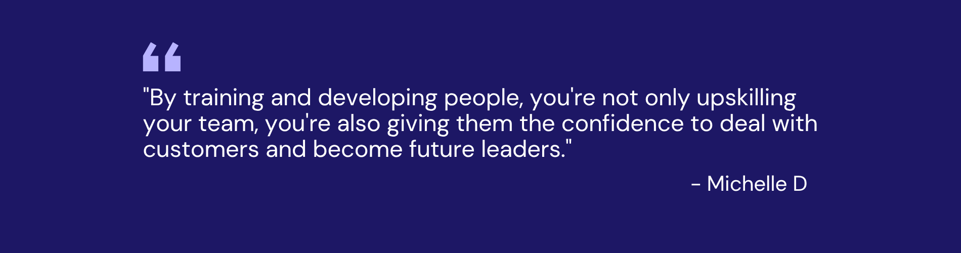
"By training and developing people, you're not only upskilling your team, you're also giving them the confidence to deal with customers and become future leaders."
That’s why 1UP Cargo expects every employee to become a CargoWise Certified Professional through WiseTech Academy within their first six months.
For Michelle, the benefit is efficiency: the better people know CargoWise, the quicker they are. "You're able to navigate to find the issue, even if it's not in your everyday role," she says. She gives a simple example: a shipment's profit looks wrong. Is it the exchange rate? A team member who has completed the certification training knows to go straight into the file and find out, rather than escalating it.
Fitting that learning into a busy week is the hard part. Her advice: don't wait for a quiet moment that never comes.
"There is never a perfect time to study," she says. "You're always waiting for that slow period. It never happens." Her solution: treat development as a work commitment, book a couple of hours in the calendar, and protect them. It doesn't need to be formal. Industry articles, webinars, mentoring, and curiosity all count.
When technology meets experience
Technology has transformed the logistics industry since Michelle joined in 2018. Early in her career, the business ran on paper, email, and spreadsheets. Today it runs on data, with customers tracking their own shipments instead of phoning to ask.
She is a big believer in automation and AI and expects both to keep reshaping logistics. But none of it, she says, changes what the industry fundamentally is. "We're still a service industry. A robot cannot do that personal touch."
She believes technology and people aren't in competition. Technology gives teams the speed and visibility to act; people bring the judgment and the relationships. The Zambia shipment is a case in point: when the plan fell through twice, the team kept moving. And the technology, CargoWise, enabled them to action their decisions quickly.
That's why she keeps investing in her team as the tools around them evolve. "Embracing change while developing people is critical for effective leadership in modern logistics.”
When disruption arrives, capability isn't something you build in the moment. It's something you built before you needed it.